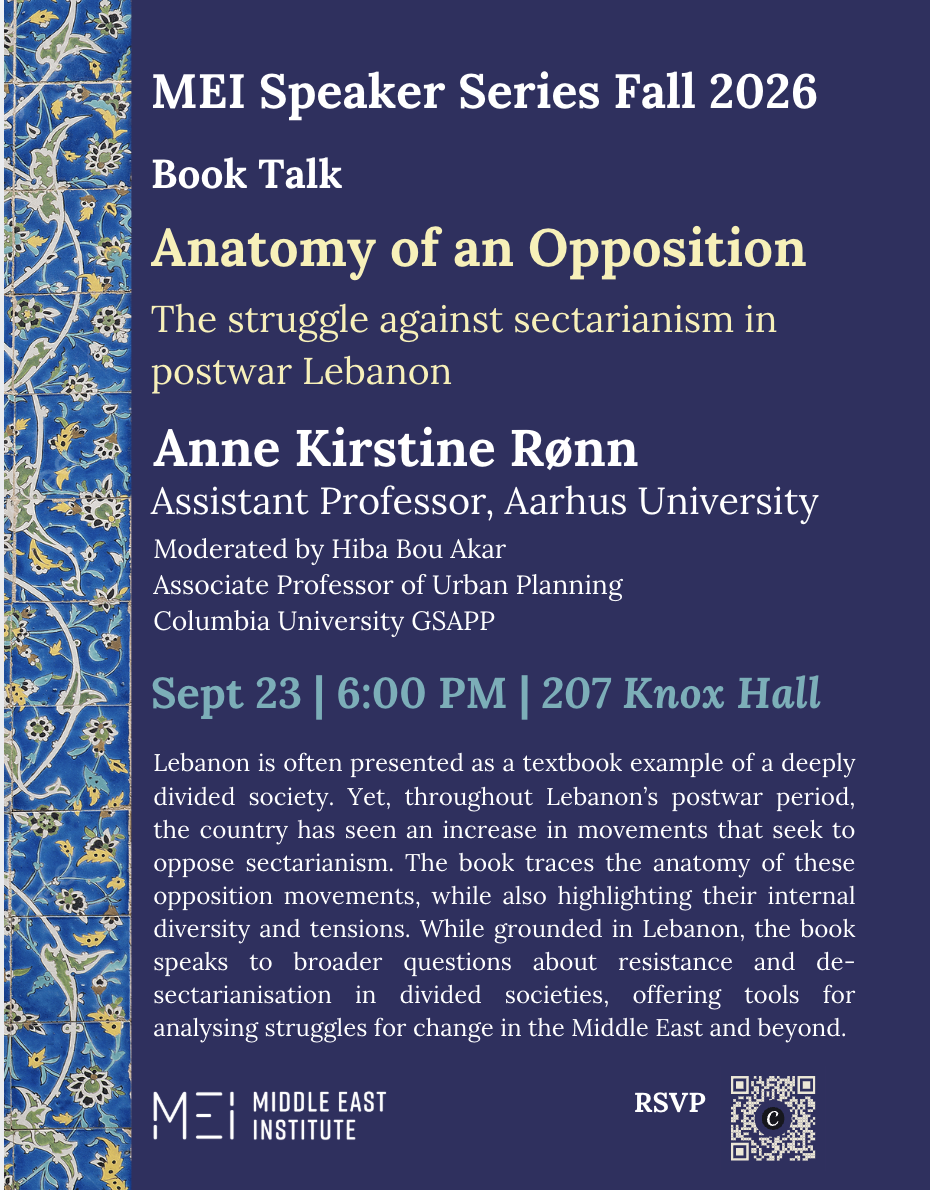
Lebanon is often presented as a textbook example of a deeply divided society, where religious or sect-based identities remain the dominant forces shaping social and political life. These divisions manifest from top state institutions of sect-based power sharing down to the welfare distribution and everyday interactions, obstructing the formation of political communities that unite citizens around shared demands for accountability and social rights. Yet, throughout Lebanon’s postwar period, the country has seen an increase in movements that seek to oppose sectarianism. The book traces the anatomy of these opposition movements, examining their key characteristics and strategies, while also highlighting their internal diversity and tensions. Drawing on Pierre Bourdieu’s concepts of doxa, field, habitus, and capital, the book argues that sectarianism in Lebanon functions as a taken-for-granted truth, or doxa, and that efforts to confront it unfold across different domains, which constitute separate battlegrounds between the ruling elites and their challengers. Through fieldwork-based analyses, the book explores five key battlegrounds: electoral politics, labour and class, urban space, gender and sexuality, as well as migration and refugee rights. It examines cases ranging from the 2019 October Uprising to local lobbying campaigns for inclusive public spaces. The book also adopts an intersectional approach, showing how sectarianism relates to other social identities, and how opposition movements sometimes reproduce social hierarchies, modes of exclusion and marginalisation based on these identities. While grounded in Lebanon, the book speaks to broader questions about resistance and de-sectarianisation in divided societies, offering tools for analysing struggles for change in the Middle East and beyond. The book will be published with Manchester University Press in September as part of the series 'Identities and Geopolitics in the Middle East'.
Anne Kirstine Rønn is an Assistant Professor in the Department of Political Science at Aarhus University. Her research focuses on political opposition and social movements in ethno-religiously divided societies, especially in Lebanon and Iraq, exploring how diasporas, labour movements, and protest dynamics shape change. Prior to joining Aarhus University, Anne Kirstine was a Carlsberg Foundation Postdoctoral Fellow and a Visiting Fellow at the LSE Middle East Centre.