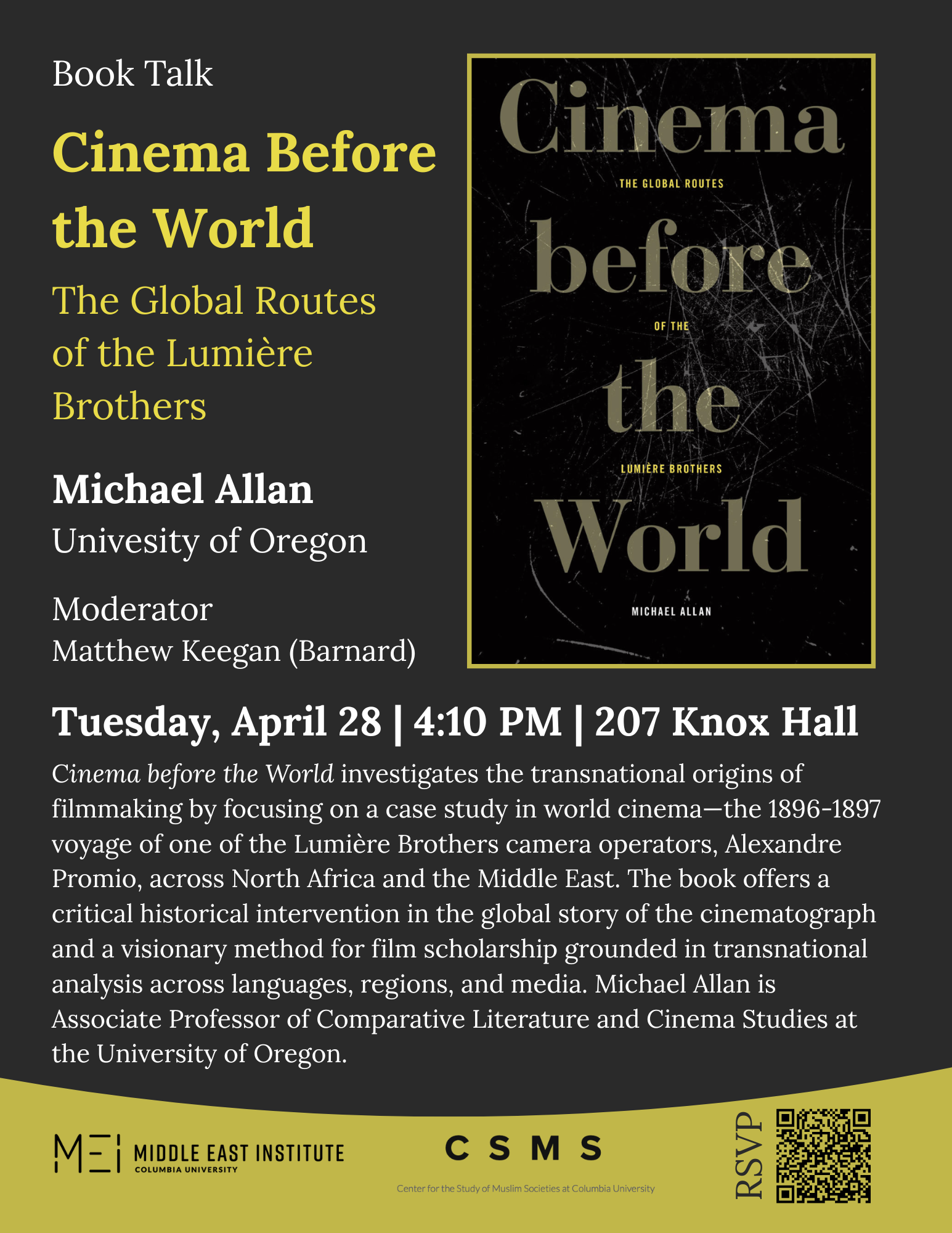
Book Talk - "Cinema Before the World: The Global Routes of the Lumière Brothers"
Book talk with Michael Allan, Associate Professor of Comparative Literature and Cinema Studies at the University of Oregon.
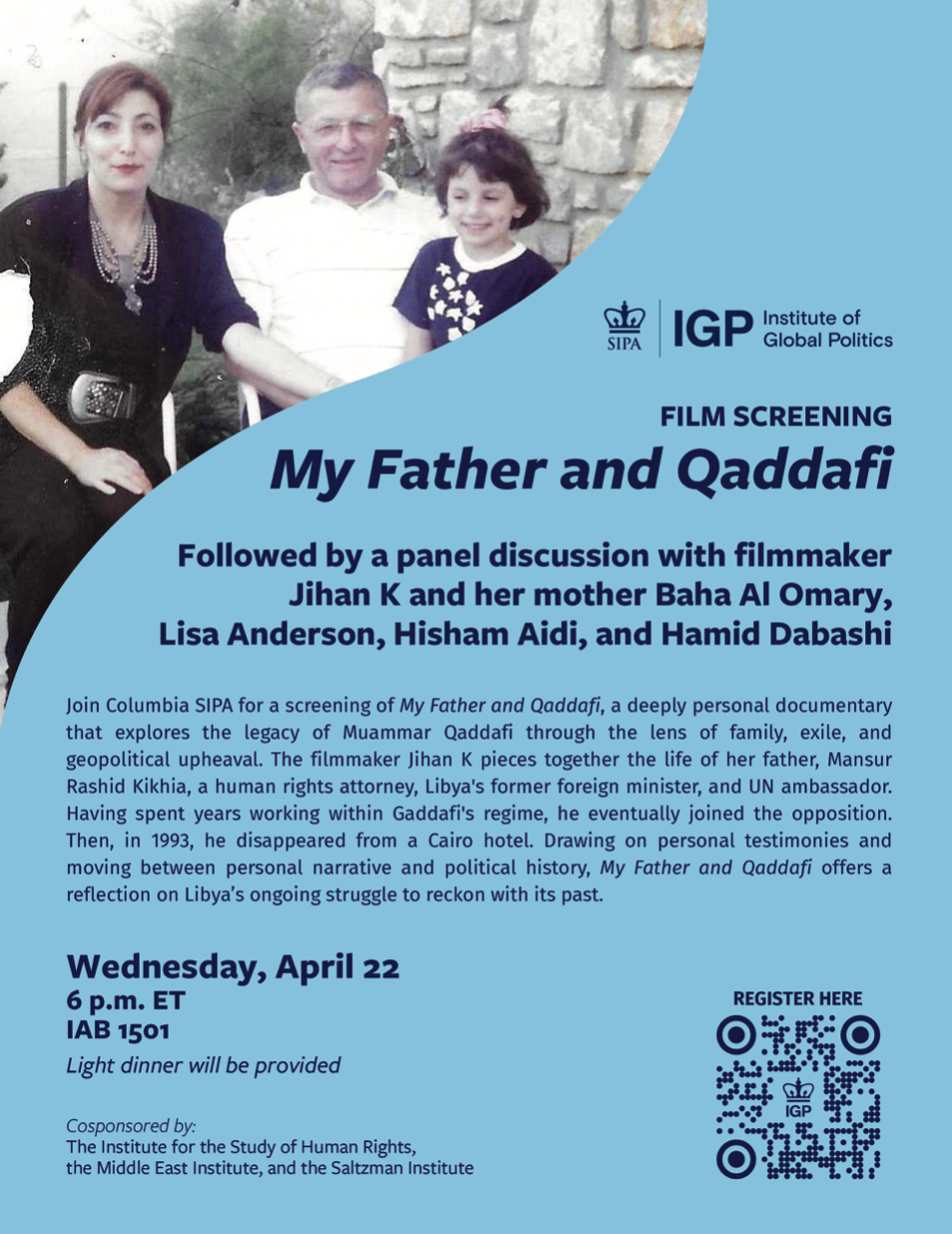
A screening of My Father and Qaddafi, a documentary by Jihan K, followed by a panel with the filmmaker and Columbia faculty.
Join the Middle East Institute and the Center for the Study of Muslim Societies for our latest Sharīʿa Workshop with Mohamed Iqbal Mitiche. We will discuss his paper “Toward a Fiqh of Spiritual Abuse: A Methodological Intervention.”
Featuring Naama Harel (Columbia) in conversation with Brian Boyd (Columbia). Hosted by Hamid Dabashi (Columbia).
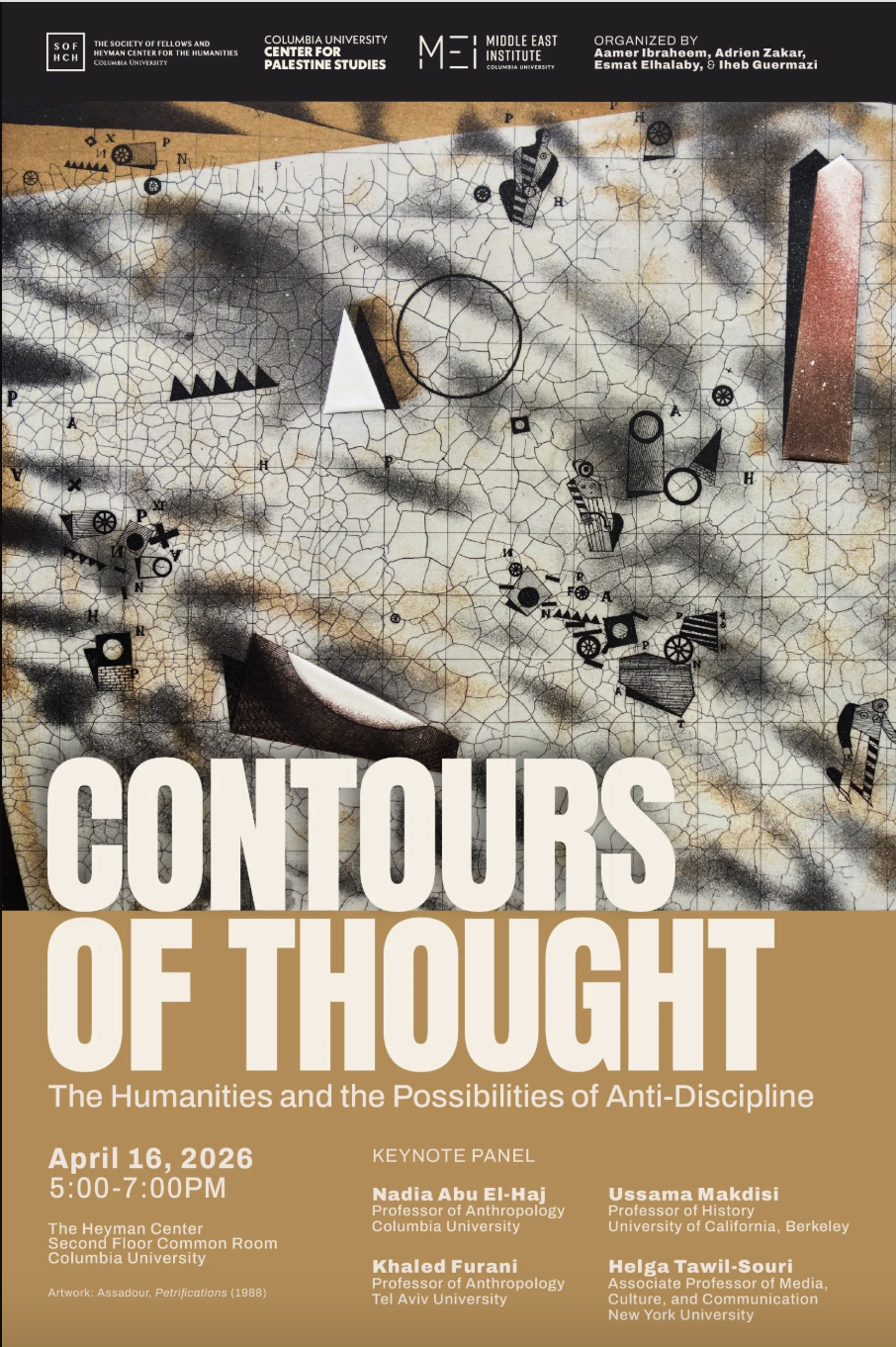
The symposium brings together scholars working across and beyond Middle East and North Africa studies to explore how discursive fields are constituted, and to ask what becomes possible when we read across and against established disciplinary and regional boundaries.
A lecture with Samuel Sami Everett titled “Maghrebi Jewish Return,” drawing on his new book The Jewish Maghreb.
Join Columbia Global Center Amman and the Middle East Institute for the Morningside Campus in-person watch party of the live webinar A System Under Strain: Can Refugee Protection Keep Pace with Global Displacement?, followed by a moderated discussion.
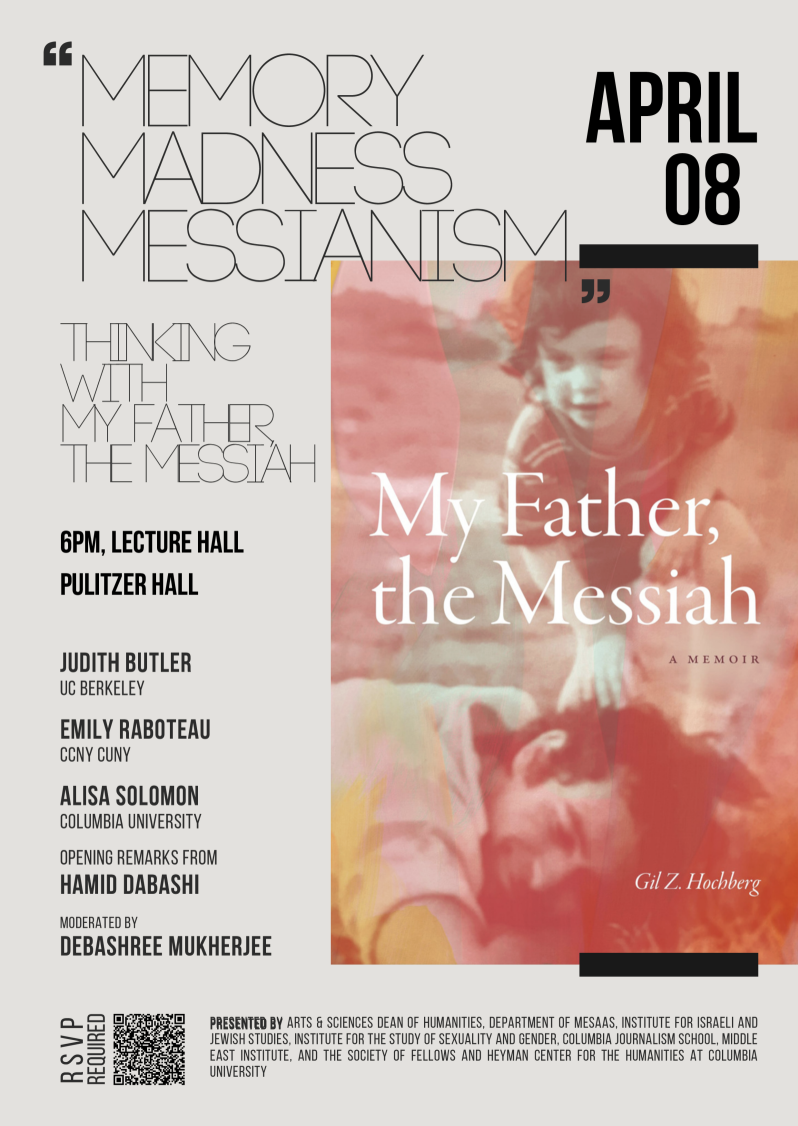
Join us for a panel discussion with Judith Butler (UC Berkeley), Emily Raboteau (CCNY), and Alisa Solomon (Columbia University) with opening remarks from Hamid Dabashi (Columbia University) and moderated by Debashree Mukherjee (Columbia University), celebrating the release of Gil Z. Hochberg's memoir, My Father, the Messiah (Duke 2025.)
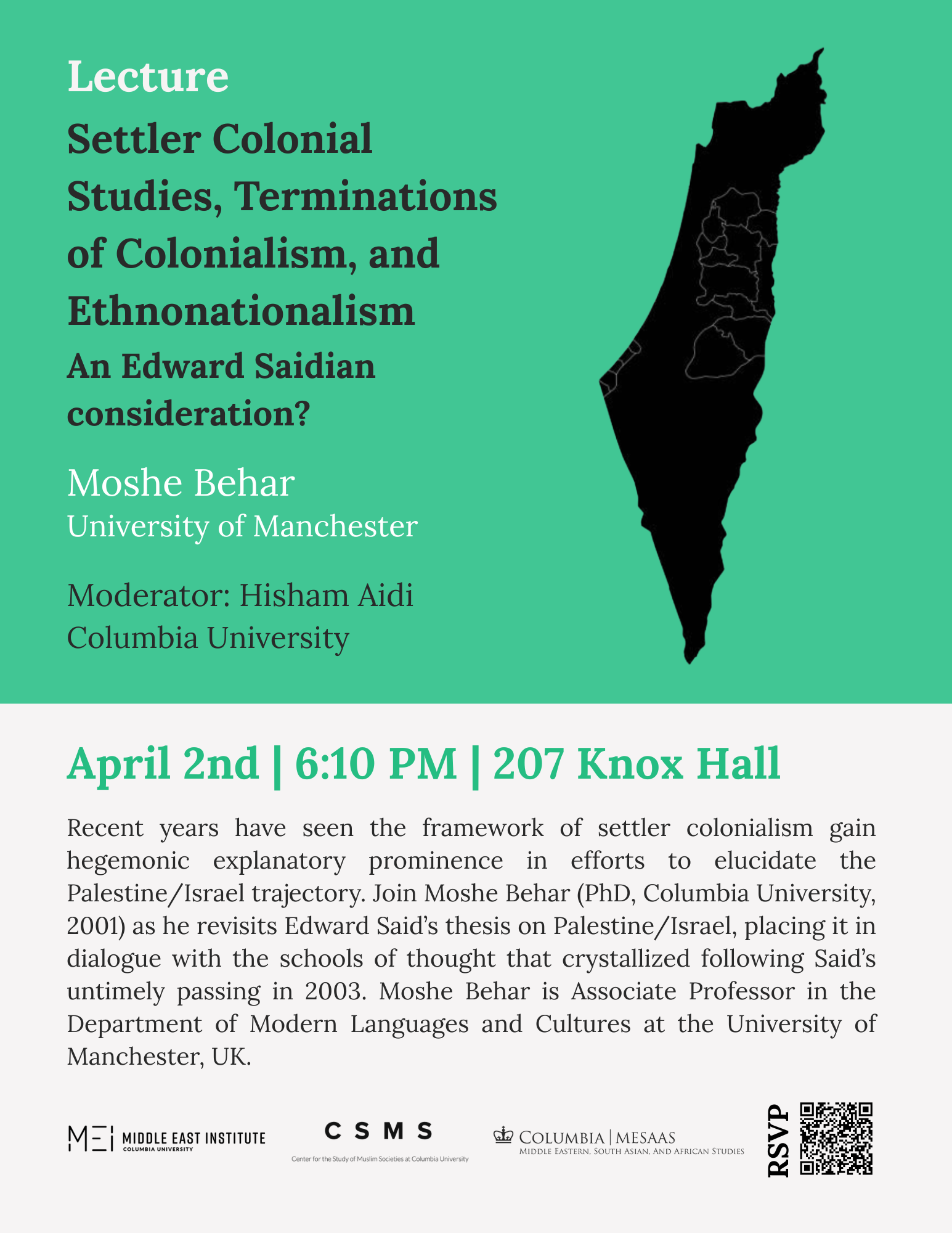
A lecture with Moshe Behar (University of Manchester) titled “Settler Colonial Studies, Terminations of Colonialism, and Ethnonationalism: An Edward Saidian consideration?”
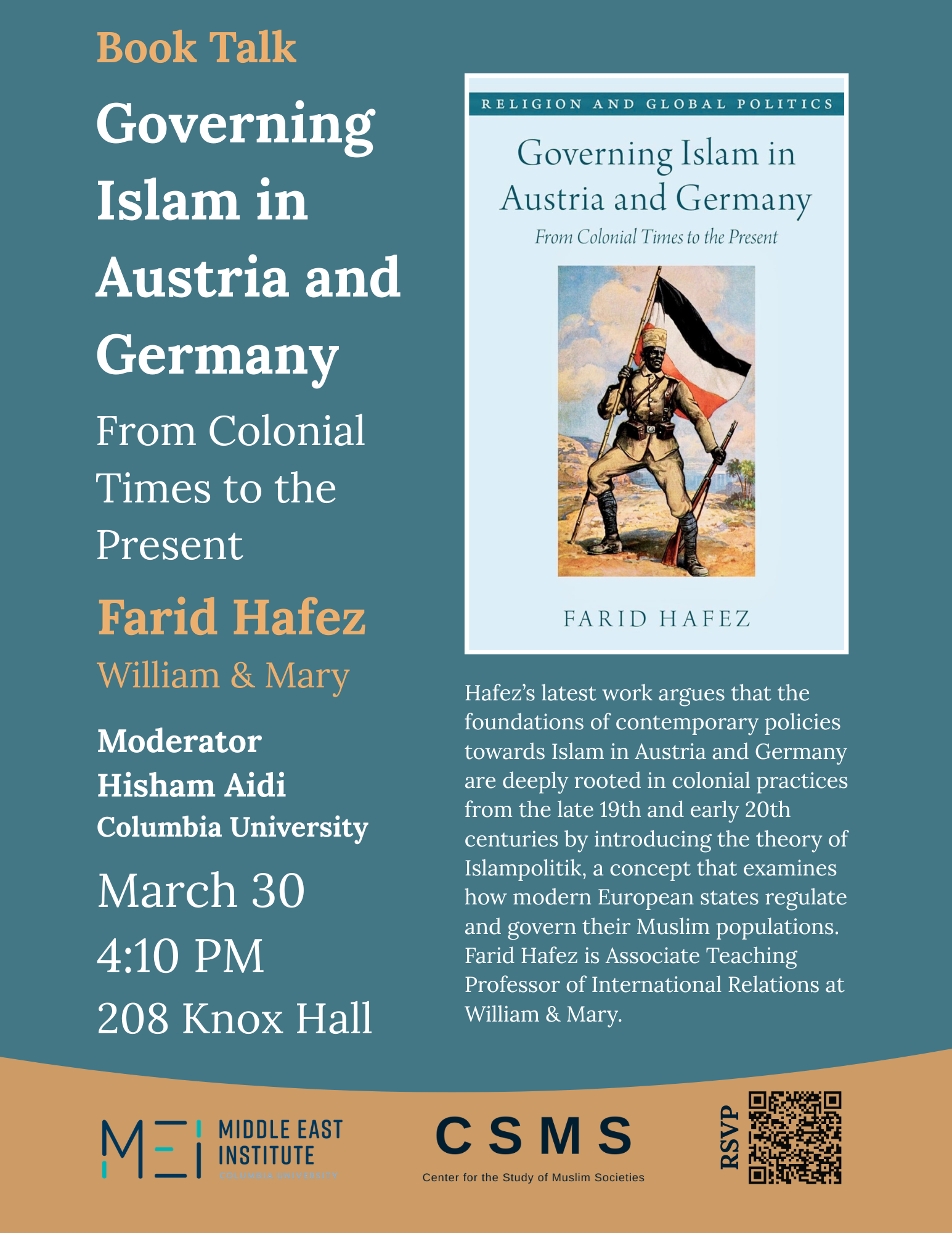
MEI and CSMS present a book talk with Farid Hafez (William & Mary) for his latest work titled Governing Islam in Austria and Germany.
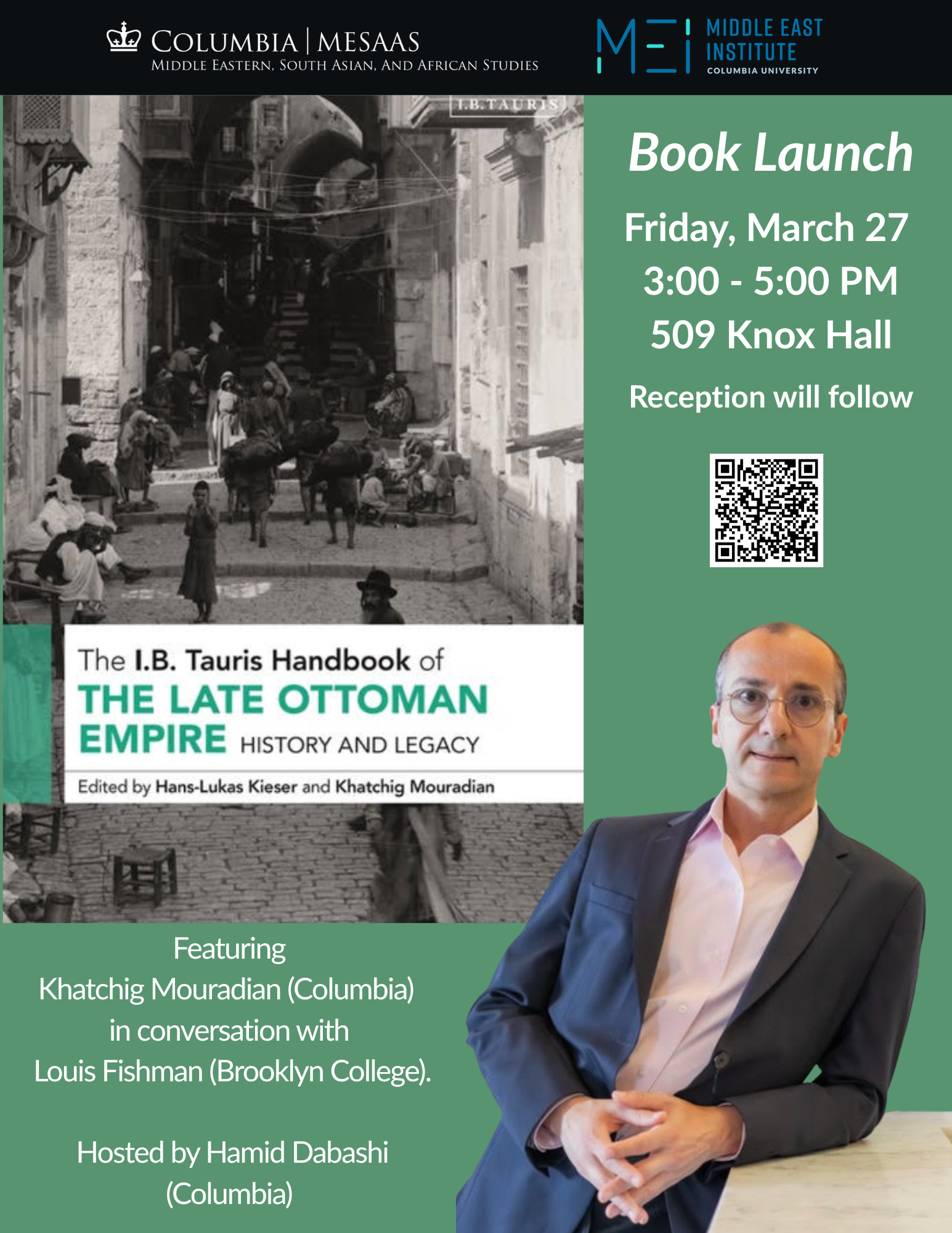
Featuring Khatchig Mouradian (Columbia) in conversation with Louis Fishman (Brookline College). Hosted by Hamid Dabashi (Columbia)
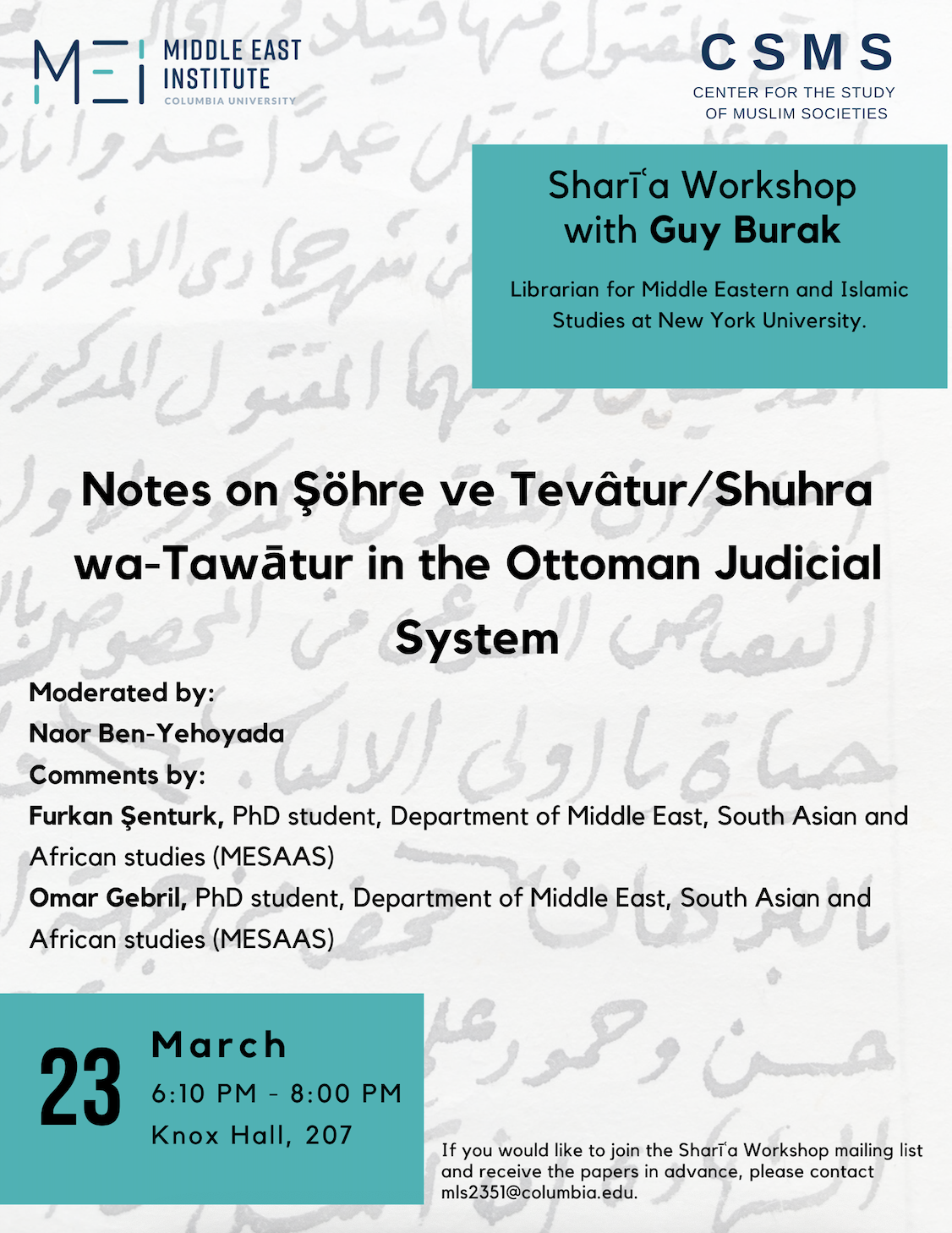
Join the Middle East Institute and the Center for the Study of Muslim Societies for our latest Sharīʿa Workshop with Guy Burak. We will discuss his paper “Notes on Şöhre ve Tevâtur/Shuhra wa-Tawātur in the Ottoman Judicial System.”
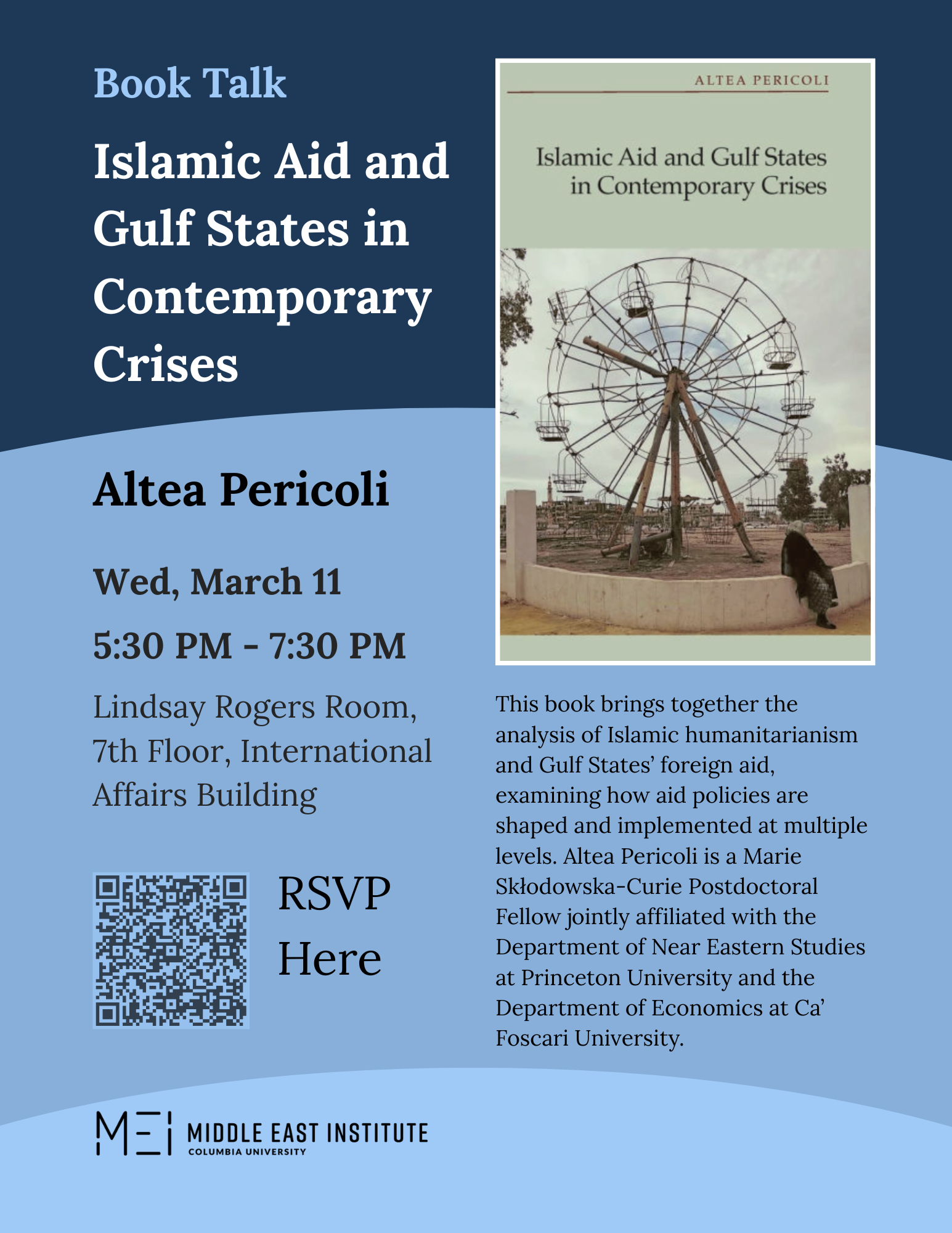
Join Altea Pericoli for a talk about her new book, Islamic Aid and Gulf States in Contemporary Crises.
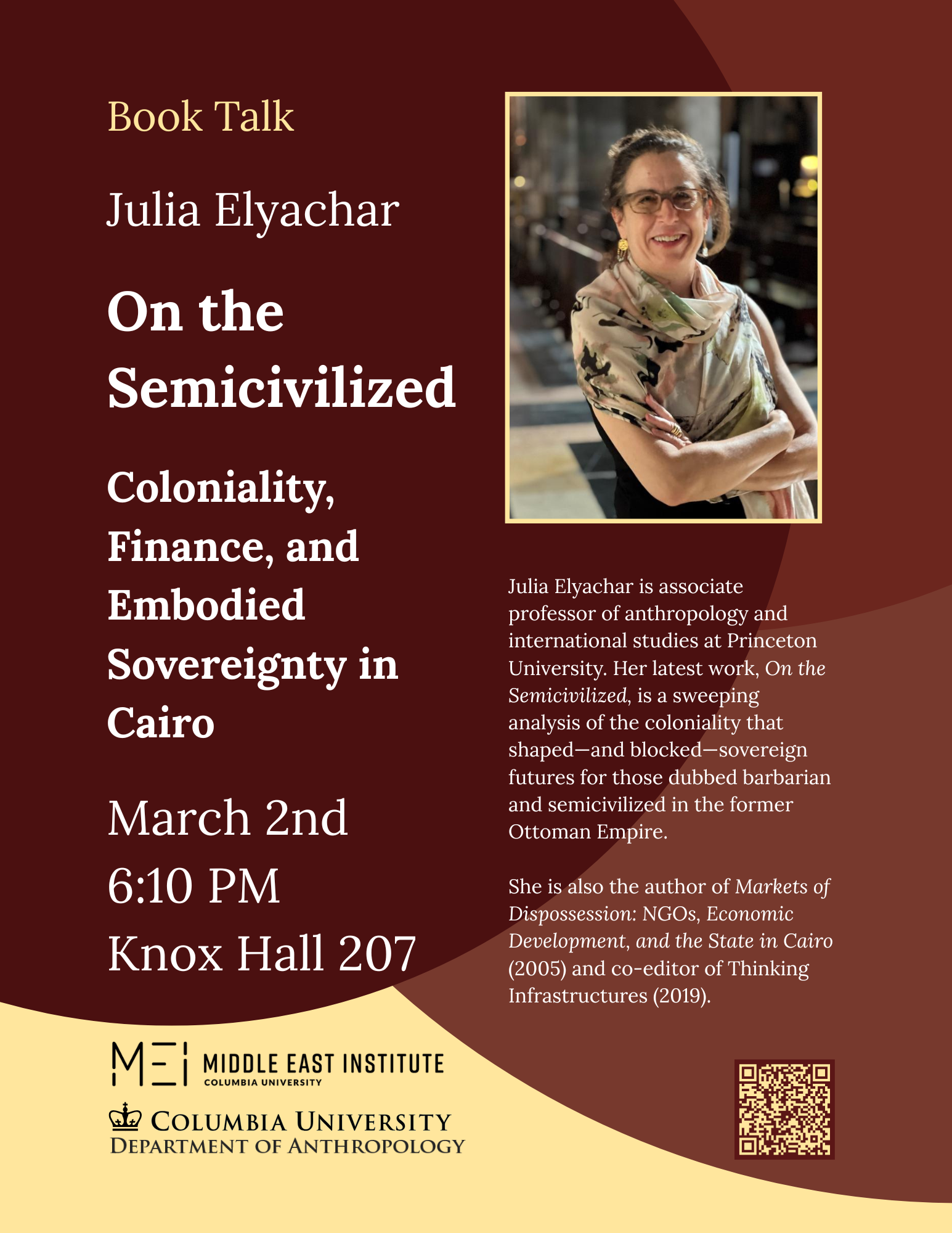
On the Semicivilized: Coloniality, Finance, and Embodied Sovereignty in Cairo by Julia Elyachar is a sweeping analysis of the coloniality that shaped—and blocked—sovereign futures for those dubbed barbarian and semicivilized in the former Ottoman Empire.
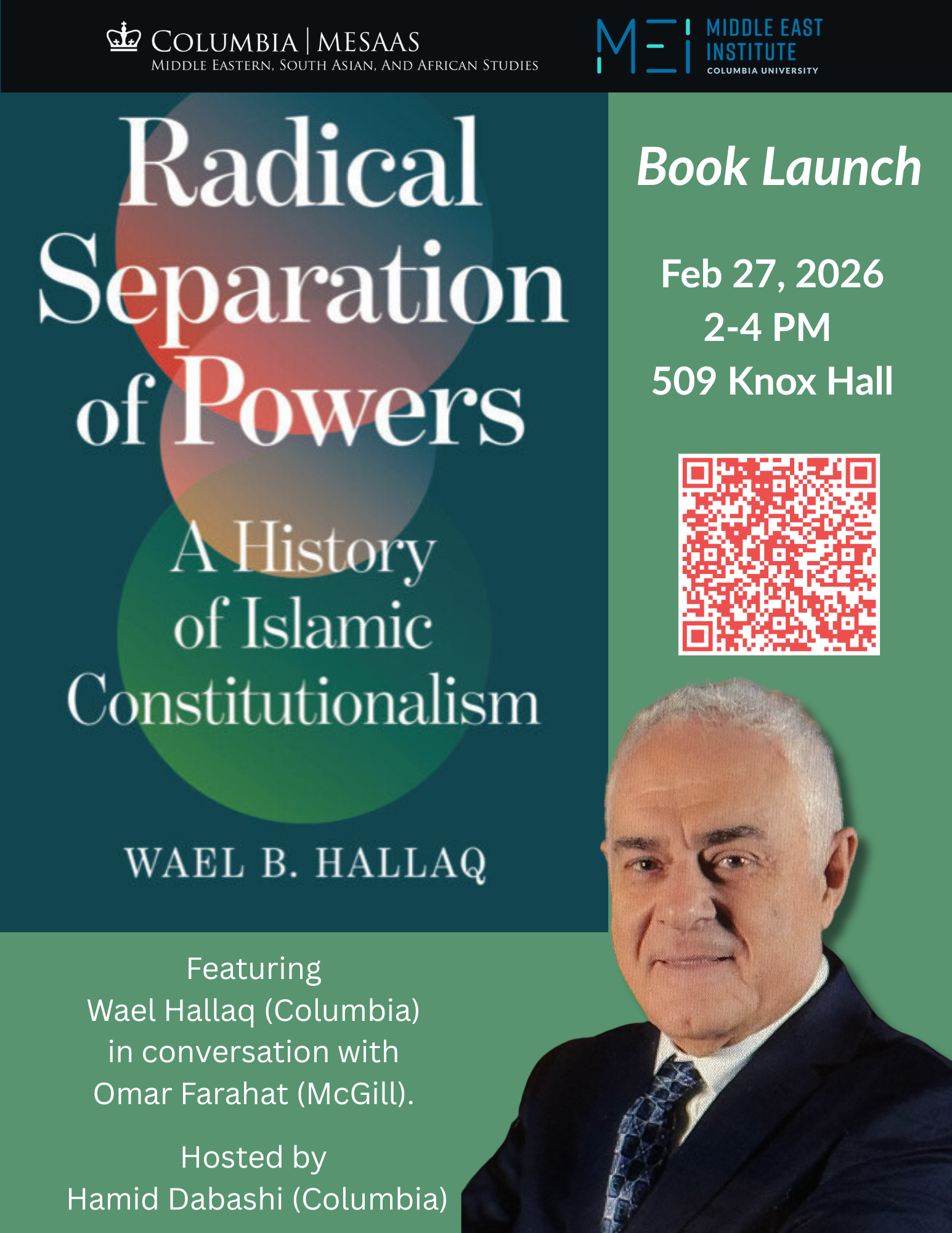
Wael Hallaq (Columbia) in conversation with Omar Farahat (McGill). Opening and Concluding Remarks Hamid Dabashi (Columbia).
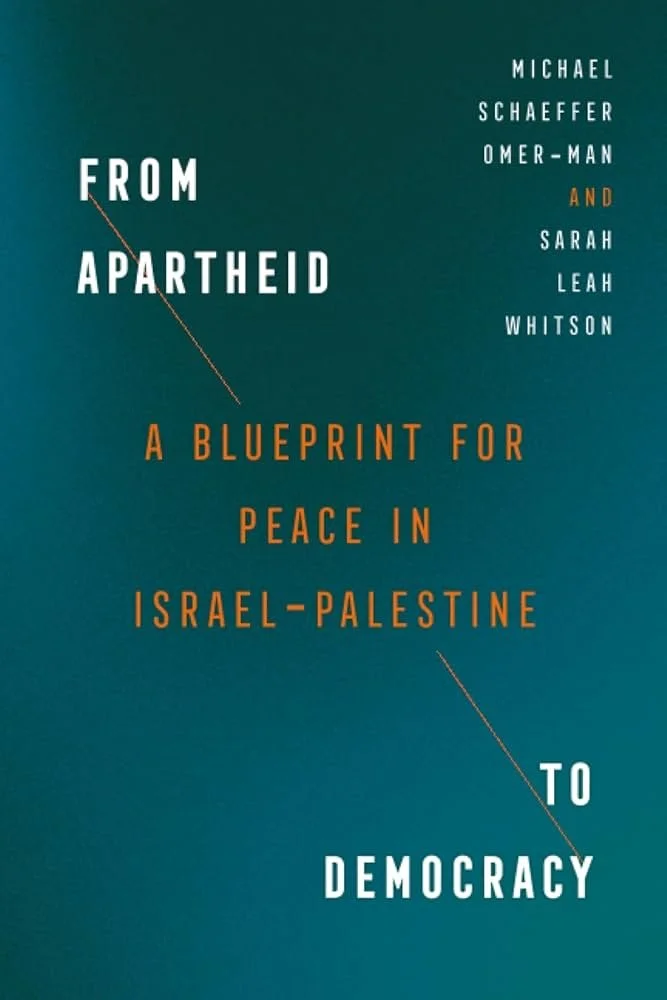
Book talk with authors Mike Omer-Man and Sarah Leah Whitson, Moderated by professor Lisa Anderson.
Book Talk with Daryoush Mohammed Poor. Moderated by Hamid Dabashi.
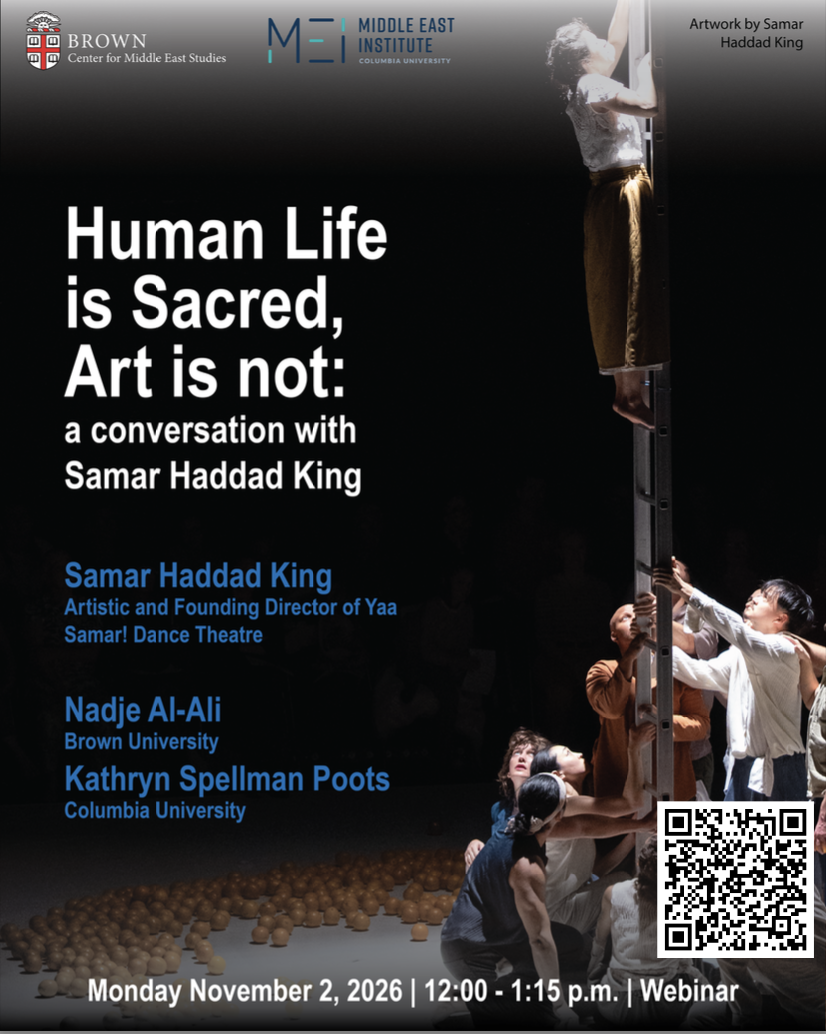
Kathryn Spellman Poots and Nadje Al-Ali will be in conversation with the Turkish-Kurdish artist Fatma Bucak as part of their series on gender, art and body politics with reference to the Middle east and its diasporas.
A Philosophical Treatise on Muslim Politics: Wisdom and Governance is an English translation of Hairi Yazdi’s Ḥikmat wa ḥukūmat by Daryoush Mohammed Poor. This event will be moderated by Hamid Dabashi.
Please join us for a discussion of the recently published report, 'Our Genocide' by The Israeli Information Center for Human Rights in the Occupied Territories, B'tselem. Speakers Yuli Novak and Kareem Jubran will be joined by Professor Diana Greenwald to discuss the research and its significance in the fight against genocide in Palestine.
Book Talk with Amy Malek, Associate Professor of Anthropology and American Studies at William & Mary College.
The Middle East Institute is proud to be associated with the “Water and Oil” exhibition at the European Cultural Center’s “Time Space Existence” architecture biennial.
Date: Monday, May 5th
Time: 12:00 PM
Location: Zoom (registration required)
Join us for a special virtual event in conjunction with Inscriptions Unbound: Edward Said’s Library, the exhibition currently on view at Butler Library.
Joy Al-Nemri (MESAAS alumna and curator of the exhibit) will offer insights into the curatorial process and the intellectual significance of the personal inscriptions drawn from Said’s private book collections. Her reflections will highlight how these often-overlooked marginalia trace a cartography of intellectual intimacy, solidarity, and transnational connection.
Timothy Brennan (author of Places of Mind: A Life of Edward Said) will speak to Said’s intellectual legacy, drawing on his extensive biographical and scholarly work to explore Said’s place in contemporary thought, and the ongoing relevance of his commitments to justice, critique, and humanism.
This event invites students, scholars, and readers of Edward Said to consider the material and affective afterlives of his library, and the ways in which books—and the inscriptions within them—can serve as living archives of intellectual history.
Exhibit on view at Butler Library, 3rd Floor, through May 15, 2025.
Date: Wednesday, April 30th
Time: 6:00 PM - 7:30 PM
Location: Schermerhorn hall, 807
Between 1450 and 1550, a remarkable century of intellectual exchange developed across the Eastern Mediterranean. As Renaissance Europe depended on knowledge from the Ottoman Empire, and the courts of Mehmed the Conqueror and Bayezid II greatly benefitted from knowledge coming out of Europe, merchants of knowledge—multilingual and transregional Jewish scholars—became an important bridge among the powers.
With this book, Robert Morrison is the first to track the network of scholars who mediated exchanges in astronomy, astrology, Qabbalah, and philosophy. Their books, manuscripts, and acts of translation all held economic value, thus commercial and intellectual exchange commingled—knowledge became transactional as these merchants exchanged texts for more intellectual material and social capital. While parallels between medieval Islamic astronomy and the famous heliocentric arrangement posited by Copernicus are already known, Morrison reveals far deeper networks of intellectual exchange that extended well beyond theoretical astronomy and shows how religion, science, and philosophy, areas that will eventually develop into separate fields, were once interwoven. The Renaissance portrayed in Merchants of Knowledge is not, from the perspective of the Ottoman Muslim contacts of the Jewish merchants of knowledge, hegemonic. It's a Renaissance permeated by diversity, the cultural and political implications of which the West is only now waking up to.
SPEAKER’S BIO
Robert Morrison (Columbia Ph.D. ’98) is George Lincoln Skolfield, Jr. Professor of Religion and Middle Eastern and North African Studies at Bowdoin College. He is a scholar of science in Islamic societies and Jewish cultures. He has received fellowships from the Guggenheim Foundation, the NEH, the Stanford Humanities Center, and the National Humanities Center. His previous book was The Light of the World: Astronomy in al-Andalus (University of California Press, 2016).
A. Tunç Şen is an Assistant Professor of History at Columbia University, specializing in the cultural and intellectual history of the early modern Ottoman Empire. His work focuses on the history of science and divination, manuscript culture, the history of emotions, and the social history of scholarship and education in the Ottoman world. His first book, Forgotten Experts: Astrologers, Science, and Authority in the Ottoman Empire, 1450–1600, will be out next month from Stanford University Press.
Date: Wednesday, April 30th
Time: 4:10 PM - 6:00 PM
Location: Knox Hall, Room 207
For decades, the agricultural settlements of Israel's arid Central Arabah prided themselves on their labor-Zionist commitment to abstaining from hiring outside labor. But beginning in the late 1980s, the region's agrarian economy was rapidly transformed by the removal of state protections, a shift to export-oriented monoculture, and an influx of disenfranchised, ill-paid migrants from northeast Thailand (Isaan). Capitalist Colonial, Matan Kaminer's ethnography of the region and its people, argues that the paid and unpaid labor of Thai migrants has been essential to resolving the clashing demands of the bottom line and Zionist ideology here as elsewhere in Israel's farm sector.
Kaminer's account mobilizes capitalism and colonialism as a combined analytical frame to comprehend the forms of domination prevailing in the Arabah. Placing the findings of fieldwork as a farm laborer within the ecological, economic, and political histories of the Arabah and Isaan, Kaminer draws surprising connections between the violent takeover of peripheral regions, the imposition of agrarian commodity production, and the emergence of transnational labor flows. Insisting on the liberatory possibilities immanent in the "interaction ideologies" found among both migrant workers and settler employers, and raising the question of the place of migrants who are neither Jewish nor Arab in visions of decolonization, this book demonstrates anthropology's ongoing relevance to the struggle for local and global transformations.
SPEAKER’S BIO
Matan Kaminer is Lecturer is a Lecturer at the School of Business and Management, Queen Mary University London. He holds a PhD in Anthropology from the University of Michigan and an MA in Sociology and Anthropology from Tel Aviv University. A long-time activist, he has participated in movements against militarism and occupation, in solidarity with migrant workers, and for the democratisation of academic life. Kaminer’s research on agricultural labour migration from South and Southeast Asia to the Middle East encompasses geo-political and geo-economic processes from the perspective of the most marginalised. His work has appeared in journals such as American Ethnologist, The International Journal of Middle East Studies, and Millennium.
Date: Friday, April 11
Time: 12 PM
Location: The Heyman Center, Second Floor Common Room, Columbia University
Meet two writers who have arrived at the personal essay form via different avenues. Sara Mokhavat, an actress and filmmaker has written about how it is to be a working woman - particularly in the arts - in Iran. Vali Khalili, a once traditional journalist who, because of the vagaries of living in an authoritarian state has turned more to the craft of essay writing in order to understand the lives of youth and women in his country - but even more importantly, in order to convey what it means to be a man in Iran after the Woman Life Freedom movement. Together these writers and their translator, Salar Abdoh, will discuss the arc of their various careers as they unfold in real time inside Iran rather than the usual reductive narratives generally available from both liberal and reactionary media when discussing the complex and diverse social milieu of Iran.
This event is part of the Against the Grain: Gender and the Fraught Politics of Translation in Persophone World series. These spring events are themed, "In Their Own Words: Iranian Lives and the Personal Essay." Learn more about the series here.
SPEAKERS
Sara Mokhavat is a graduate in Film Studies and Directing from the College of Cinema & Theater in Tehran. For her feature film effort in The Guns of Nane Kardar, she was a finalist as Best Female Role in the 2011 Fajr International Film Festival. Her novel, A Woman Who was Found in the Lost & Found, was published in 2017 and her play, Goodbye My Cherry Orchard, was staged in 2018. Her first short film, Shogun, was made in 2019 and her second film, Private, was shown at the 2021 Chicago International Film Festival and also won the Directors Beyond Borders prize at the Discover Film festival in London. Her latest efforts are Lovebirds, 2023, and Home, 2024. She is also a writer of personal essays concerning women’s lives in Iran that have been published recently in the international magazine of arts & literature, The Markaz Review.
Vali Khalili is currently the managing editor of the economic magazine, Ayandeh Negar and a reporter for Tragedy magazine in Iran. He studied Communications & Journalism at the Azad University of Tehran and ever since has held positions at some of the most important journals and newspapers in Iran, including Shargh Daily, Etemad and Hamshahri. He is a co-writer of the volume, Without Smoke, Fire and Blood (2021), dealing with America’s unprecedented economic sanctions on Iran, and his reporting and essays have appeared in such international venues as The Atlantic, The Markaz Review and Asymptote. He has also twice been nominated for the prestigious True Story international award in Switzerland and once for the Private Eye Writers of America Shamus Award for the short story, “Fear is the Best Keeper of Secrets” in the collection, Tehran Noir. Two anonymously written essays have also been published in the collection, Woman Life Freedom (London, 2023). He lives and works in Tehran.
Salar Abdoh was born in Iran and splits his time between Tehran and New York City. He is the editor of Tehran Noir and author of several novels, most recently Out of Mesopotamia, which was a New York Times Book Review Editors’ Choice and one of Publishers Weekly’s best books of 2020, and A Nearby Country Called Love, just released in paperback by Penguin and called “a complex portrait of interpersonal relationships in contemporary Iran” by the New York Times and “brutally poignant” by the Washington Post. A prolific essayist and translator as well, Abdoh teaches in the MFA program at the City College of New York.
Mana Kia was born in Iran and is Associate Professor in the Department of Middle Eastern, South Asian, and African Studies at Columbia University. She is an interdisciplinary scholar of the connected histories of early modern Persianate Asia with a focus on the circulation of people, texts, practices, and ideas just before the dominance of modern European colonial power. She is the author of Persianate Selves: Memories of Place and Origin before Nationalism (Stanford, 2020), which was translated into Persian last year. She was a 2023-2024 Heyman Center Fellow.
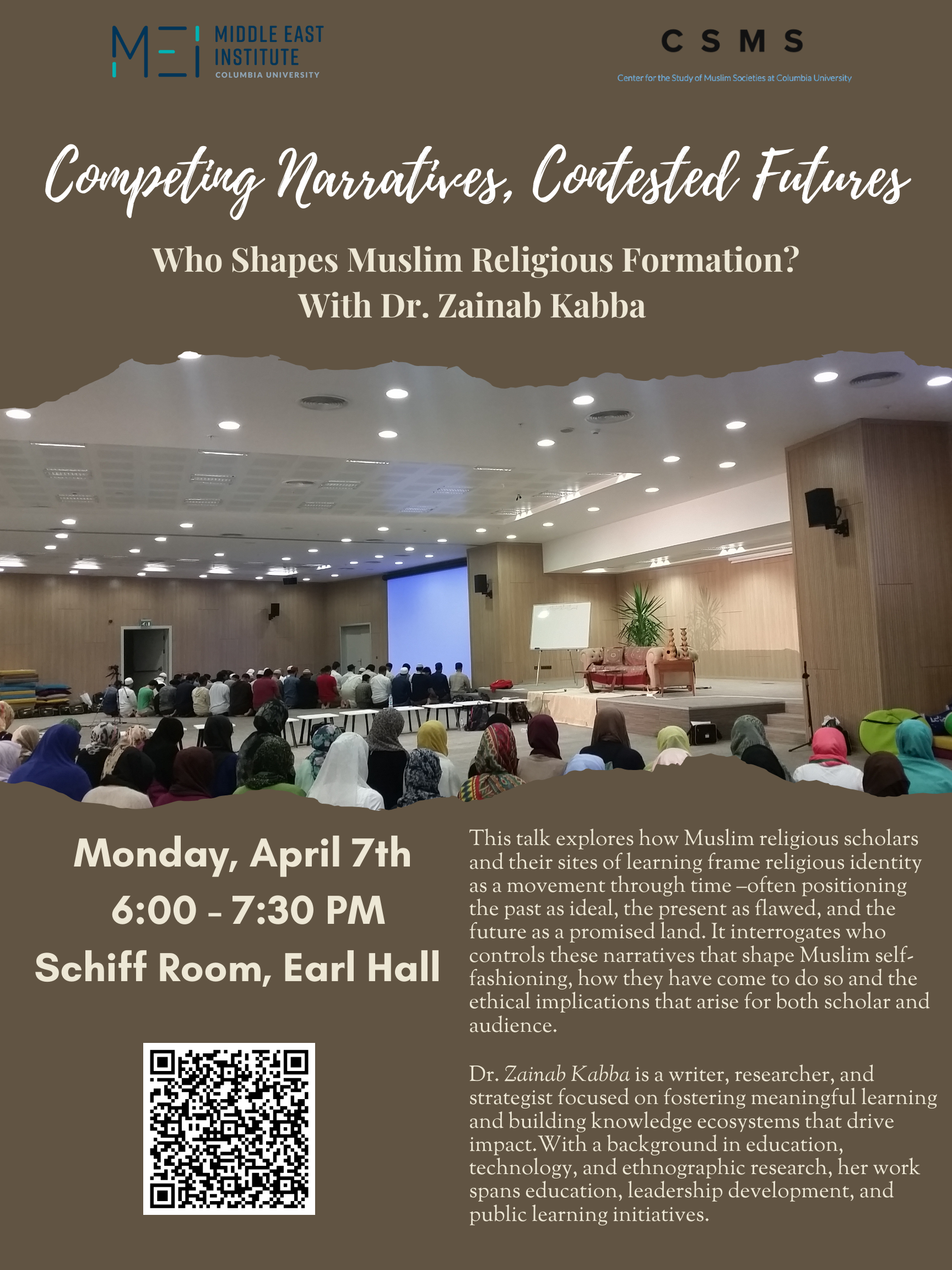
Date: Monday, April 7
Time: 6:00 PM - 7:30 PM
Location: Schiff Room, Earl Hall
This talk explores how Muslim religious scholars and their sites of learning frame religious identity as a movement through time –often positioning the past as ideal, the present as flawed, and the future as a promised land. It interrogates who controls these narratives that shape Muslim self-fashioning, how they have come to do so and the ethical implications that arise for both scholar and audience.
Dr. Zainab Kabba is a writer, researcher, and strategist focused on fostering meaningful learning and building knowledge ecosystems that drive impact. As Founder and CEO of Quotidian Strategies, she helps organizations navigate complexity through data insights, evaluation, and everyday phenomena. With a background in education, technology, and ethnographic research, her work spans education, leadership development, and public learning initiatives. She is the author of Knowledge, Authority, and Islamic Education in the West and designs spaces for learning, connection, and nuanced practice. Dr. Kabba holds a DPhil from the University of Oxford and an MA from Teachers College, Columbia University.
Date: Thursday, March 27
Time: 6:30 PM - 8:00 PM
Location: East Gallery, Maison Française, Buell Hall
Leila Albayaty, 2024, 92 min. In Arabic, English and French with English Subtitles
US Première. Screening introduced by Emi Schlosser
After suffering amnesia from an accident, Leila, a young French artist of Iraqi origin, reconstructs her history by reconnecting with her family and delving into her roots. She learns Arabic, interprets the poems of her politically exiled Iraqi father, and immerses herself in the history of the Gulf War in Iraq. An inner journey, an identity quest sublimated by her songs, bridging Europe and the Middle East.
Watch trailer here
Leila Albayaty is a French-Iraqi multidisciplinary artist known for her work as a film director, composer, singer, actress, and scriptwriter. Born in Auvergne, France, to a French mother and an Iraqi father, she pursued studies in violin, opera, architecture, and cinema before forging her own path as a self-taught artist.
Her debut short film, Vu (2009), received a Special Mention from the Jury at the Berlinale and was showcased at numerous international film festivals. She followed with her first feature film, Berlin Telegram (2012), which premiered at Indielisboa and won the TV5 Award for Best Francophone Film. In 2015, she released Face B, a hybrid documentary-fiction that premiered at the Berlinale Forum Expanded. Her latest film, From Abdul to Leila (2024), is a feature documentary that delves into the intersection of Western and Arab cultures through the lens of her French-Iraqi family history. Currently, Albayaty divides her time between Belgium, France, Germany, and Egypt, continuously exploring themes of cultural identity and personal narrative across her diverse body of work.
This event is part of a short series of documentary films on the theme of "In the Middle: Women Documenting Struggles" produced by Maison Française and co-sponsored by the Center for Palestine Studies, MESAAS and Middle East Institute at Columbia University. With additional support by the Institute of African Studies. Join us on March 6, Sudan, Remember Us (Soudan, souviens-toi) by Hind Meddeb, 2024, followed by a Q&A with director Hind Meddeb and Thomas Dodman.
The Columbia campus is currently open only to Columbia-affiliated guests (with a CUID). Outside guests who register to attend a public event will be allowed to enter campus for the event if we provide their names and emails to Public Safety the day before. Please be sure to register for any events at least 48 hours ahead of time and you will get an email from caladminnoreply@columbia.edu with a unique QR code giving you access to the campus. Don't forget to bring your ID with you.
Date: Thursday, March 27
Time: 1:00 PM - 2:00 PM
Location: International Affairs Building (SIPA), 404
As Syria remains a focal point of geopolitical tension and humanitarian concerns, diplomacy plays a crucial role in shaping its future. This moderated discussion will explore the current state of diplomacy in Syria, examining which global and regional powers are engaging with the country, their interests, and the broader implications for the Middle East.
The speakers will discuss the evolving relationships between Syria and key international players—including the U.S., Russia, China, Turkey, Iran, and Arab states—as well as the impact of shifting alliances and normalization efforts in the region. This conversation will also consider the humanitarian situation, reconstruction challenges, and Syria’s place in broader regional security dynamics.
The event will feature Marcelle Shehwaro, a Syrian activist and writer, and Mariam Jalabi a political activist with The Syrian Women’s Political Movement and Representative of the National Coalition to the UN.
The sponsors for this event are the CRC, The Human Rights and Humanitarian Policy (HRHP) Concentration, Middle East Institute (MEI), and the Policy and Security Working Group (PSWG). The partners for this event are International Security Policy (ISP) Concentration, International Conflict Resolution (ICR) Specialization, and the Gender and Public Policy (GPPS) Specialization.
Kindly note that this event has been postponed until further notice.
This conference will visit key historical and contemporary debates on Zionism and Judaism, including several declarations on the subject of anti-semitism over the past decade: among them the IHRA Working Definition, the Jerusalem Declaration, and the Nexus Document. The conference will focus on The Jewish debate over Zionism, on writing of a history of Zionism, violence and non-violence, and decolonization.
Convened by Mahmood Mamdani. Co-sponsored by the Middle East Institute and Iffriqiya.